Niger and other countries across the Sahel region have strong solar resources, but they also present specific challenges for photovoltaic projects. High ambient temperatures, intense solar radiation, airborne dust, seasonal sandstorms and limited water availability can all affect the long-term performance and maintenance requirements of a solar power system.
For distributors building local inventory, project developers and solar installers, selecting the right LONGi modules is therefore not simply a matter of choosing the highest wattage available. The more important question is whether the module design, electrical characteristics and maintenance requirements match the local operating environment.
This guide explains the key factors to consider when selecting LONGi solar panels for Niger and other hot, dusty West African markets.
1. Understand the Sahel Operating Environment
The Sahel has a combination of environmental conditions that should be considered during module selection.
High ambient and module temperatures
Solar modules operate at temperatures above the surrounding air temperature when exposed to strong sunlight. Under sustained high-temperature conditions, cell temperature can become significantly higher than ambient temperature. Since module output generally decreases as cell temperature rises, temperature performance is an important selection factor.
Dust accumulation and soiling
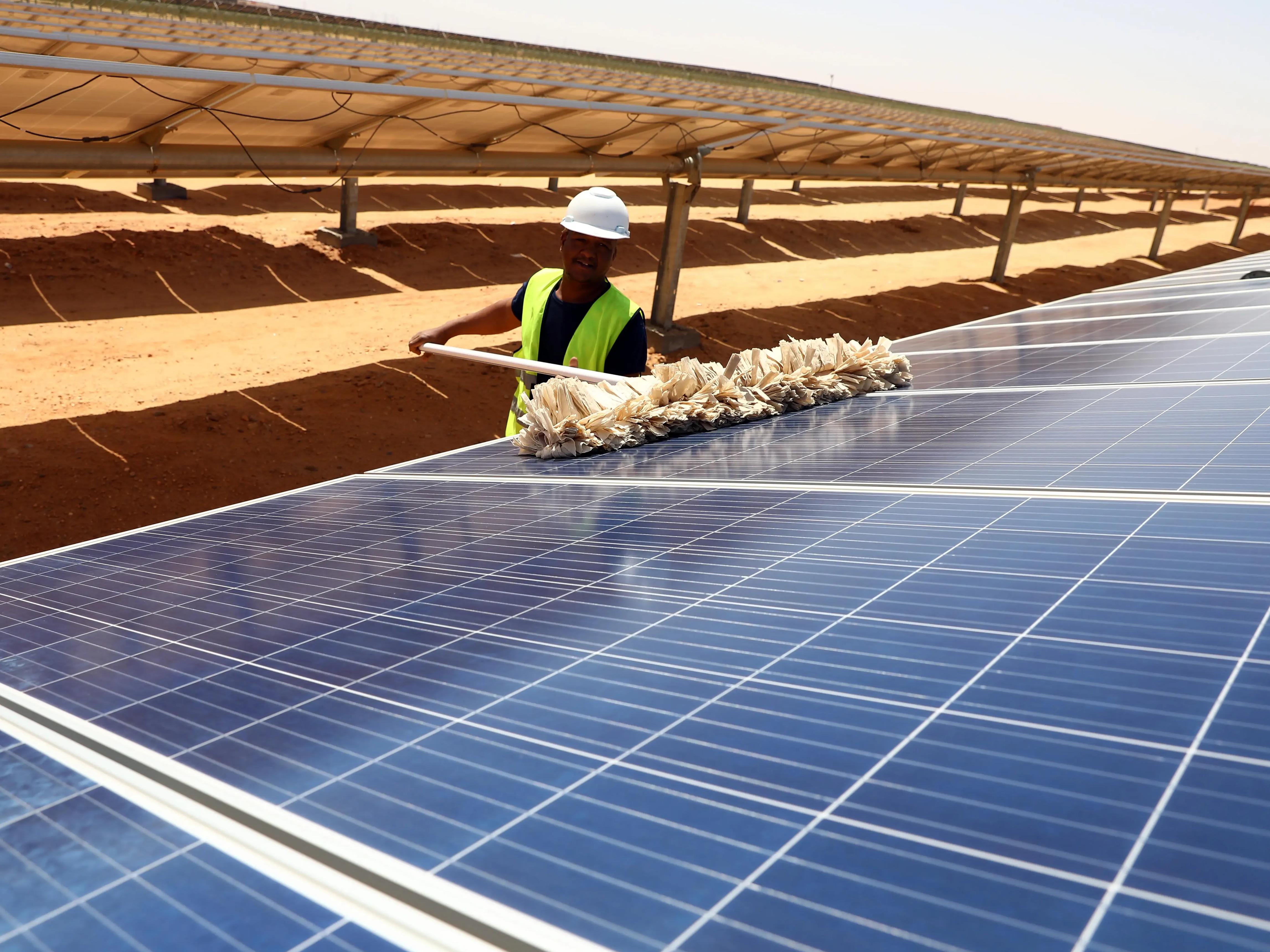
Dust can accumulate on the front glass and reduce the amount of sunlight reaching the cells. The impact depends on particle size, humidity, wind, module tilt, rainfall and cleaning frequency. In areas with long dry seasons, natural rainfall may not provide sufficient cleaning.
Limited water and maintenance resources
In some locations, frequent wet cleaning may be expensive or impractical. A module selection strategy should therefore consider not only initial power output but also how easily the array can be maintained over its operating life.
Transport and installation conditions
Long-distance inland transportation, handling at project sites and installation under challenging conditions also matter. Packaging, mechanical strength, mounting design and installation quality all contribute to long-term reliability.
These factors should be assessed together rather than treated as separate product specifications.
2. Temperature Coefficient: An Important Factor in Hot Climates
One of the first technical parameters to compare is the temperature coefficient of maximum power, usually expressed as %/°C.
It indicates how much a module's maximum power changes as its cell temperature rises above the standard test reference temperature of 25°C. A less negative coefficient generally means a smaller power reduction for each degree of temperature increase.
For example, LONGi's published Hi-MO X10 Guardian Anti-Dust specifications list a Pmax temperature coefficient of approximately -0.260%/°C. This is a useful reference when evaluating the product, but buyers should always check the datasheet for the exact model and power class being quoted.
It is important not to interpret the coefficient as a guarantee of actual plant output. Real energy production also depends on irradiance, module orientation, ventilation behind the modules, inverter operating conditions, shading, soiling and system losses.
For Niger projects, buyers should compare the temperature coefficient of the specific LONGi models under consideration and use local temperature data in the energy-yield simulation.
3. Dust Resistance: Look Beyond the Glass Surface
Dust is not only a cleaning issue. It can create uneven shading across a module and, under certain conditions, contribute to localized heating and additional performance losses.
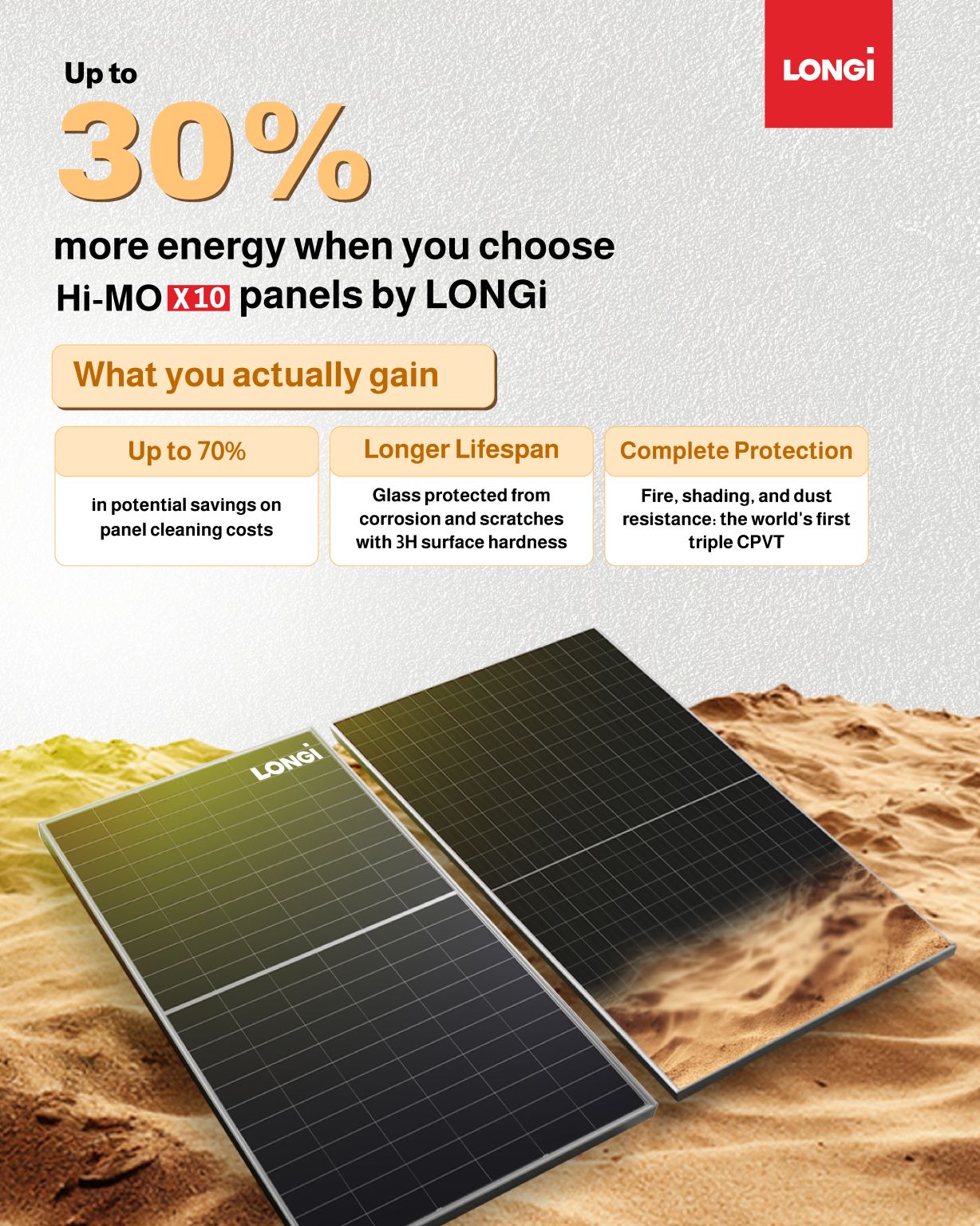
LONGi has introduced the Hi-MO X10 Guardian Anti-Dust design for dust-prone environments. Its design approach includes dust-resistant glass and a short-edge frame structure intended to reduce dust accumulation around the module surface and frame area.
For buyers in Niger, this type of design deserves consideration, particularly where the project is exposed to frequent dust accumulation and cleaning resources are limited.
However, an anti-dust design should not be understood as a dust-proof module that never needs cleaning. No module design can eliminate soiling losses under all site conditions. The actual benefit will depend on the local dust composition, wind direction, mounting angle and maintenance practices.
When comparing products, ask the supplier to confirm:
The exact model number and datasheet of the proposed anti-dust module.
Whether the quoted product is the Guardian Anti-Dust version or another Hi-MO X10 configuration.
The applicable warranty and installation requirements.
Whether the proposed model is available in the required power range and quantity.
This avoids confusion between different products within the same module family.
4. Should You Choose the Highest-Wattage LONGi Module?
Not necessarily.
Higher-wattage modules can reduce the number of panels required for a given DC capacity. This may reduce the number of module connections, mounting points and installation operations, depending on the system design.
However, higher wattage alone does not determine the best module for a project.
The engineering team should also check:
Module dimensions and weight: Larger modules may require compatible mounting structures, suitable handling equipment and sufficient installation space.
Electrical compatibility: Open-circuit voltage, operating current, short-circuit current and maximum series fuse ratings must match the inverter and system design.
String configuration: The minimum and maximum operating temperatures at the site affect string voltage calculations. The design must remain within the inverter's allowable DC voltage and current limits.
Transport and replacement: A locally stocked module that can be replaced with the same model or an electrically compatible alternative may be more practical than a product that is difficult to replenish.
For a local distributor, a consistent and clearly defined product range can be more valuable than stocking many different models with overlapping specifications.
5. Glass-Glass or Glass-Backsheet: Which Should You Consider?
Both module constructions can be suitable for utility-scale and commercial solar projects. The correct choice depends on the product's certified specifications, project design, installation environment and commercial requirements.
Glass-glass modules may be considered where buyers prioritize a dual-glass construction and the specific product's durability and warranty characteristics. Glass-backsheet modules may also be appropriate where their weight, mechanical design and electrical specifications better suit the project.
There is no universal rule that glass-glass modules are automatically better for every dusty or hot location.
For projects in Niger, buyers should focus on the exact LONGi model, its construction, mechanical load ratings, warranty conditions and compatibility with the mounting structure. Dust performance should be assessed separately rather than inferred from the presence of a second glass layer.
6. Cleaning and Maintenance Should Be Part of the Selection
Even when a module has a dust-oriented design, a cleaning plan remains necessary.
Before purchasing, project owners and distributors should consider:
How quickly dust accumulates during the dry season.
Whether cleaning can be performed with an adequate and reliable water supply.
Whether dry-cleaning equipment is available and suitable for the module manufacturer's instructions.
How frequently the array should be inspected.
Whether the mounting angle and site layout allow safe access for maintenance.
LONGi's module operation and maintenance guidance should be followed for cleaning methods. In general, cleaning should avoid abrasive tools and unsuitable chemicals, and should be carried out under safe temperature and electrical conditions. For hot regions, early morning or evening is generally preferable to cleaning modules when they are extremely hot.
A realistic maintenance plan is essential. A module with attractive laboratory specifications can still deliver disappointing field results if soiling is not managed.
7. Which LONGi Modules Should Buyers Evaluate?
For Niger and nearby West African markets, buyers can begin by comparing mainstream LONGi high-power modules with the relevant Hi-MO X10 Guardian Anti-Dust options.
The selection should be based on the project's application and actual supply requirements:
Utility-scale solar plants: Prioritize power density, electrical compatibility, mechanical loading, energy-yield modelling and long-term supply consistency.
Commercial and industrial rooftops: Consider roof loading, available installation area, module dimensions and maintenance access.
Local distribution inventory: Focus on power classes with clear market demand, consistent availability and practical replacement options.
Dust-intensive sites: Evaluate the specific Guardian Anti-Dust model and compare its documented design features with the site's cleaning conditions.
A supplier should provide the exact model code rather than quoting only a broad product-family name. Buyers should also confirm the actual power bin, connector type, cable configuration, packaging and delivery schedule before placing a bulk order.
Click here to Learn more about Longi Hi-MO X10 Anti-dust module
8. What Should You Confirm Before Buying LONGi Modules?
For distributors building stock in Niger, the purchasing decision should include more than the module price.
A practical procurement checklist includes:
Exact model and power range: Confirm the complete model number and the available wattage bins.
Product authenticity: Request traceable product information and relevant supply documentation.
Warranty: Confirm the applicable product and power warranties for the specific model and purchase channel.
Quantity and packaging: Check pieces per pallet, pallets per container and loading arrangements.
Export logistics: Confirm the destination, shipping route, Incoterms, inland transportation requirements and estimated lead time.
After-sales support: Clarify how technical questions, warranty claims and replacement requirements will be handled.
For a distributor, continuity of supply is particularly important. If a certain model becomes the main product in the local market, future replenishment and replacement compatibility should be considered from the beginning.
9. LONGi Module Supply for West African Markets
MoregoSolar supports international buyers sourcing LONGi solar modules for distribution and project requirements. Rather than recommending a model based only on its headline wattage, the selection process should begin with the destination, application, operating environment, required quantity and target delivery schedule.
For buyers in Niger, the most useful starting point is to compare suitable high-power LONGi models with the available Hi-MO X10 Guardian Anti-Dust options, then confirm the exact specifications and supply conditions for the intended order.
A suitable module is not simply the one with the highest power rating. It is the one that balances energy yield, environmental conditions, system compatibility, maintenance requirements and dependable supply.
Planning a LONGi module purchase for Niger or another West African market? Share your target quantity, application and preferred delivery schedule with MoregoSolar to check suitable models and current supply options.